
How to Hire a Mold Remediation Contractor: What to Check Before You Sign
Hire a mold remediation contractor whose authorization and crew qualifications you can verify, with a written plan that addresses the moisture source, defines the work, and explains how completion and added charges are handled. If licensing, scope, or moisture responsibility is unclear, don’t sign yet. Ask for a corrected proposal or another qualified opinion.
Start with the right kind of contractor
Before collecting bids, decide what kind of work the house needs. A mold remediator removes or cleans affected materials. A mold assessor or qualified industrial hygiene professional investigates how far the contamination spreads and may write a remediation protocol. A plumber, roofer, or HVAC specialist may need to fix the water problem. Someone else may rebuild the wall or ceiling afterward.
The EPA says homeowners can often handle a straightforward mold patch smaller than approximately 10 square feet, roughly 3 by 3 feet. Extensive water damage, contaminated water, suspected HVAC involvement, and occupants with particular health vulnerabilities change that decision even when the visible area is small. For a larger or complicated problem, get a professional assessment before demolition begins. Tell every cleanup company whether the water source has been found.
Give each contractor the same short description of the location, affected material, water history, suspected moisture source, and access limits.
Example: visible growth on basement drywall below a previously leaking pipe. The pipe repair is complete, but nobody has inspected the wall cavity. Remediation and drywall restoration may require separate contractors. At the end of the job, check the work area, the materials and the debris.
Verify licensing and the people who will do the work
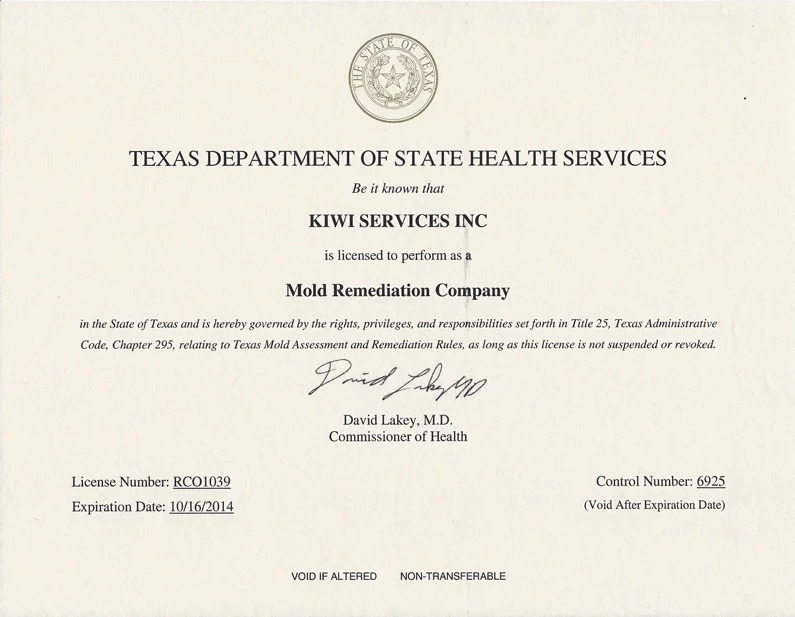
Mold-remediation licensing is regulated differently across the United States. Start with the regulator in the state where the property is located, then find out which people and business entities must hold authorization.
A real certificate on a website can still belong to the wrong role. The supervisor, the company on the contract, and the technicians at your door can each hold different qualifications.
| State | Who or what is regulated | What to verify |
|---|---|---|
| New York | Its mold program covers assessor, remediation contractor, supervisor, and worker roles under Article 32, with exceptions. Business and individual licensing are separate. | Use the New York Department of Labor Mold Program and its contractor search. Check the contracting business and the individual’s authorization for the assigned role. |
| Florida | DBPR licenses individuals who provide regulated mold assessment and remediation services. It has no separate mold-business license for companies. The definitions involve work greater than 10 square feet, with exceptions. | Identify the licensed individual who performs or supervises the covered service and check the Florida DBPR License Search. |
| Texas | TDLR has individual and company licensing categories. Its 25-contiguous-square-foot threshold works within a specific exemption framework. | Check the company and individual roles using Texas TDLR mold guidance. A licensed contractor on a smaller project still has professional obligations. |
The EPA’s homeowner cleanup guideline and these state licensing definitions answer different questions. A patch small enough for household cleanup doesn’t exempt a licensed business from its professional requirements.
Professional credentials serve another purpose
The Institute of Inspection Cleaning and Restoration Certification (IICRC) offers qualifications relevant to mold work. AMRT (Applied Microbial Remediation Technician) and MRS (Mold Remediation Specialist) are different individual credentials. IICRC also has a separate Certified Firm designation.
The IICRC MRS examination application requires documentation of at least 12 months of mold remediation job experience.
IICRC credentials show professional training and specialization. State rules decide the legal authorization required for regulated work.
Before signing, ask for the contractor’s legal name, license numbers and categories, the proposed supervisor’s name, and the individual credentials being advertised.

Match each license to the regulator’s record: exact legal name, credential category, status, jurisdiction, and role on your job.
IICRC provides a Global Locator and separate Certified Firm verification resources. Read each listing by its credential category and the holder’s identity.
If a sales rep says the business is certified but can’t name the person supervising your project, the qualification check is incomplete. The same goes for a license held by someone whose role on your job is unexplained.
Check the company, references, and insurance

Build a shortlist from recommendations by people who hired a remediator for a similar problem, referrals from an independent assessor if one is involved, and the IICRC directory. Screen each lead before you accept it.
A well-reviewed company still needs a traceable business identity and proof it can handle a project like yours. Confirm four things:
- Contracting identity: The legal business name, address, and contact details should match the agreement and the registration records. Know which company will invoice you and take responsibility for the work.
- Comparable experience: Ask for references from recent projects involving similar materials and conditions. An attic condensation problem and sewage-damaged basement walls require different experience.
- Reputation details: Look beyond the average star rating. Reviews that describe scope, communication, change orders, cleanup, and later disputes tell you more than general praise.
- Insurance and staffing: Request a certificate of insurance and confirmation that the coverage applies to the contracted mold-remediation work. Find out whether employees or subcontractors will do the work and who is responsible for them.
A certificate of insurance describes reported coverage. Exclusions and policy conditions decide whether a specific mold claim is covered. Workers’ compensation requirements depend on the jurisdiction and employment arrangements.

The EPA recommends checking contractors’ mold experience and references. The FTC likewise advises homeowners to investigate licensing, insurance, recommendations, and complaints before hiring a home-improvement contractor.
Read the work plan before you compare prices
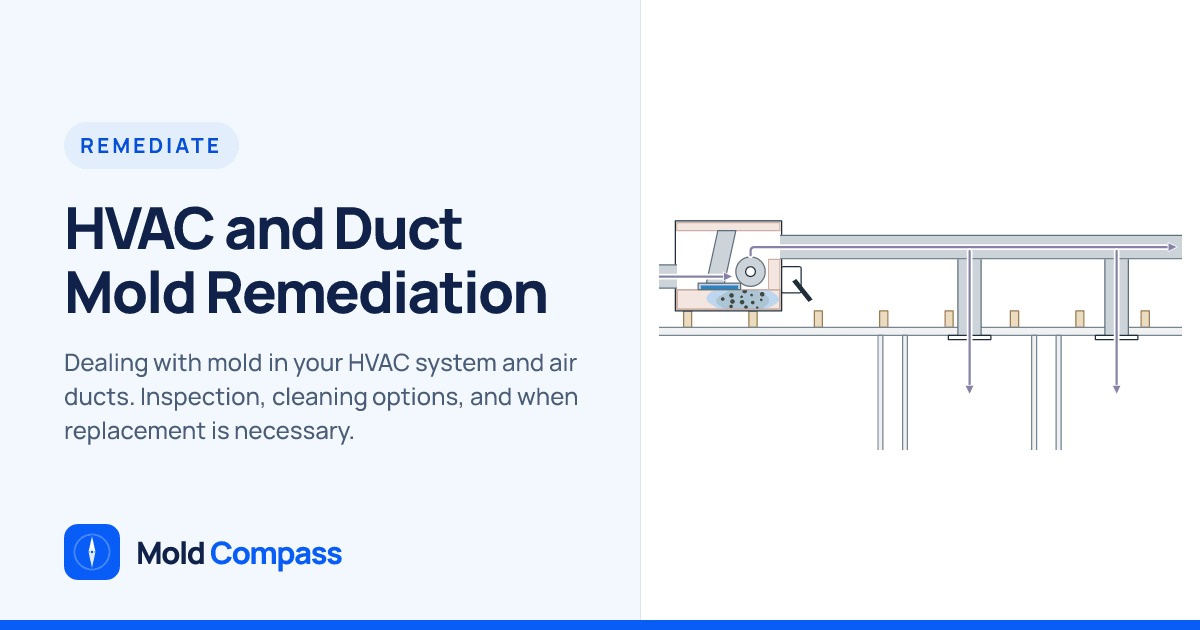
A remediation proposal should name the affected materials, explain the treatment, and account for the conditions that let mold develop.
The ANSI/IICRC S520:2024 Fourth Edition is a professional procedural standard for mold-damaged structures and contents.
A plan that promises antimicrobial products throughout a room has to explain what happens to contaminated materials, how dust and debris will be controlled, and how the original water problem will be corrected.
| Work-plan element | What the proposal should identify | Purpose |
|---|---|---|
| Affected area | Rooms, surfaces, accessible cavities, and boundaries of the proposed work | Defines what the contractor has agreed to address |
| Materials | What will be cleaned, removed, or evaluated after opening | Porous and hard materials can require different treatment |
| Moisture source | Known or suspected leak, condensation, drainage, or ventilation problem; party responsible for correction | A continuing moisture problem can support further growth |
| Containment and protection | Proposed isolation, worker PPE, HVAC precautions, debris handling, and occupant access restrictions | Controls the disturbance and movement of contaminated material during work |
| Exclusions | Areas and tasks outside the proposal | Makes unresolved work visible before the contract is signed |
EPA guidance distinguishes cleaning hard surfaces from handling porous materials that may need removal. Containment and removal methods depend on the area, materials, and water conditions. A chemical-treatment proposal needs a clear justification for the materials and conditions involved. Fogging alone doesn’t show that contaminated porous materials have been dealt with.
When two estimates describe different jobs
Hi everyone,
We have mold in our attic. We knew about it from the home inspection and got a partial credit to cover remediation.
Been getting quotes and trying to compare apples to apples has been challenging.
One quote, for $3000, is what I would call a “tactical nuke for my attic”. Essentially antimicrobial fog, bleach-like solution, repeat antimicrobial fog. No removal of ducting. Estimate is not itemized beyond labor vs material cost.
The other, for $4000, is what I would call a “surgical removal”. Essentially HEPA vacuum and antimicrobial treatment directly on visible mold patches + possibly some removal of blown in insulation near the contaminated areas. Estimate is detailed and the company feels more put together, so to speak.
Edit: The mold is concentrated at the ends of the attic and appears to be only on the wood panels nearest the vents on the edges of the attic. Sorry for not having a better way to describe that.
Edit 2: suspected cause put forward by both companies is a near complete lack of ventilation. I’m in the Seattle area so it seems that new house frequently have this problem because they build year round including when it’s raining and then moisture gets trapped in a hot box more or less for years
It seems to me like the former makes more sense since you can’t be sure where spores get kicked up during all that agitation and whatnot. But I’m not a pro. What do you think? How do I go about comparing these things?
That description doesn’t tell you which quote is right. Ask each company which materials it will treat or remove, how it will contain the disturbance, and who will fix the suspected ventilation problem.
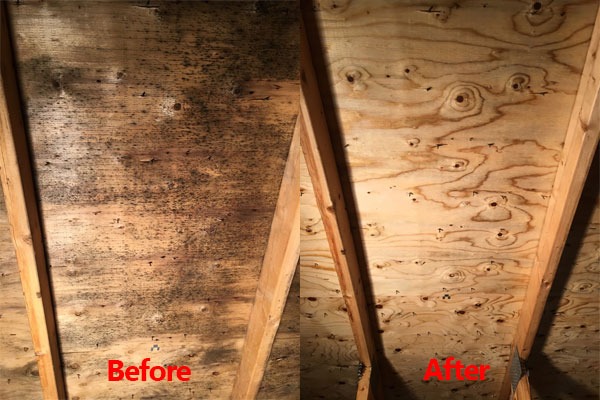
The project may involve separate trades. A remediator may work on affected sheathing while a roofing contractor handles ventilation or roof repairs. Put both responsibilities in the overall project plan.
In older buildings, demolition may disturb materials containing lead-based paint or asbestos. Where those hazards are present, the work may need additional assessment and qualified specialists.
Who assesses the mold, and when they must be independent

Assessment, remediation, laboratory analysis, and post-remediation verification are separate professional functions. Whether different parties must perform them depends on the state, the project, and the regulatory requirements. Each role appears in the professional mold-remediation process.
An assessor may establish the extent of the problem and write a remediation protocol. The remediator does the prescribed work. A laboratory analyzes samples when sampling is used. A separate professional may then evaluate the result.
An outside laboratory doesn’t automatically make an assessment independent. Who chooses the sampling locations, interprets the findings, and sets the scope also matters.
When separation is required
On covered New York mold projects, an independent mold assessment defines the remediation scope. A mold assessment licensee conducts the post-remediation assessment and, when that professional determines the work has passed, issues a written passed-clearance report. Use the three-bid comparison worksheet to line up scopes across quotes.
Florida restricts certain assessor and remediator involvement at the same structure, including business relationships, within a defined 12-month period.
Texas restricts assessment and remediation by the same dual-licensed person or company on the same project, with a specified school-district exception. For work by a licensed remediation contractor, TDLR describes a work plan that follows a licensed Mold Assessment Consultant’s protocol, including the obligations on small jobs.

Under EPA guidance, visible mold generally needs no routine sampling. Sampling can still resolve a specific uncertainty or evaluate a project, and state requirements for regulated work still apply.
When professional services arrive as separate bills
The cost of the inspection was $650 and the cost per sample was $125. With the samples we chose to do it ended up being $2900 total. We had to decline probably upwards of 20 samples because we just couldn’t afford to do all of them It’s a really big home somewhere between 3100 and 3500 square feet I think.
They asked me to give them a call back once I had a chance to look over the report so we could go over the next steps and basically those next steps would be for them to write a remediation protocol for us to then take to a remediation company which would cost $3,346 due to the size of the home and after that we’d do the actual remediation then they would come out to do a post-remediation inspection which, with sampling, he said would cost about $6,000.
On top of that of course is the cost of the actual remediation which he said because there are 16 areas in the home that need remediated could be up to $50,000 which honestly I was expecting because of how bad extensive it is.
I guess I am just wondering if the prices for the written protocol ($3,346) and post-remediation inspection ($6,000) are normal? These numbers on top of the $2,900 we’ve spent plus the cost of the actual remediation which I know is going to cost god knows how much make me more overwhelmed than I already am.
These were charges and estimates reported for one Texas property. Requirements and deliverables differ by project, so check each one separately.
Identify the assessor, protocol author, remediation contractor, and any post-work evaluator. Get each one’s deliverable and price, then find out which functions are legally required and which tests would change your decision.
Get the price, exclusions, and change orders in writing
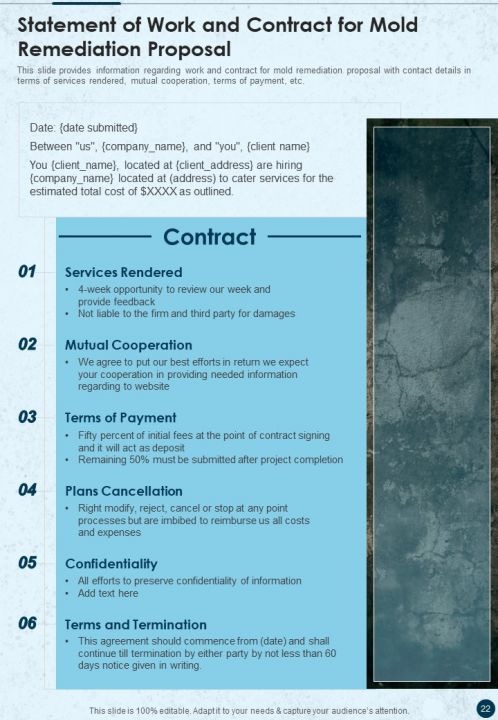
A written estimate should describe the work and the basis for its price. The FTC recommends getting multiple written estimates and reviewing the scope, materials, dates, payment arrangements, and contract terms before committing.
Start the comparison with what each contractor includes. A fixed charge for a defined task, an estimate based on assumed conditions, and time-and-materials billing expose you to different financial obligations.
| Contract item | What should be written down |
|---|---|
| Initial price | Fixed amounts, hourly or equipment rates, allowances, and estimated quantities where relevant |
| Diagnostic openings | Which walls or cavities may be opened, the minimum charge, and what happens if expected contamination is absent |
| Excluded work | Disposal, testing, drying extensions, repairs, painting, insulation, or reconstruction billed separately |
| Change orders | Who may authorize additional demolition, visits, testing, materials, or longer equipment use, and how written approval is obtained before added work |
| Payment and timing | Deposit, payment milestones, start and anticipated finish dates, cancellation terms, and final-payment conditions |
| Warranty | What specific work is covered, for how long, and what events or unresolved moisture conditions are excluded |
For example, an agreement might describe an exploratory opening in the lower two feet of a particular wall, the charge for investigating it, and who closes the opening if the expected damage is absent.
The job that ended before the bill did
Had a mold test done. Was told I had dangerous mold in my wall and it needed to be remediated. So I reached out to the company that was recommended. I was quoted $1250 and told it would take 2 days to get the job done.
After taking off work, I’m told there is no mold and they’re gone in a hour and a half. I’m then sent an invoice for $1250. When asking for a discount since the work and time that I was told would be needed wasn’t I’m told $1250 is the discounted price.
Now I’m stuck with a $1250 bill, a hole in my wall, and sour taste in my mouth that obviously isn’t mold.
A minimum service charge is fair if you agreed to it up front, even when the visit runs short. Get the charge, the scope of investigative work, and who repairs the opening in writing beforehand.

Review payment milestones and cancellation terms just as carefully. The FTC warns homeowners about high-pressure sales tactics, demands for full payment upfront, cash-only requirements, and incomplete contracts. Deposit, cancellation, and lien rules depend on state law and the circumstances of the agreement.
If a contractor wants your signature now and the contract still has blank fields, stop.
Agree on completion, documentation, and rebuilding
The agreement should define what the contractor delivers when cleanup ends and who handles the work that follows.
A completion report can describe what the remediator did, but some projects require or call for separate professional verification. The EPA has no federal airborne mold concentration limit that serves as a universal certificate of building safety. When sampling is justified, interpret it against the project’s conditions and the requirements that apply.
| Responsibility | Expected deliverable | Who handles it |
|---|---|---|
| Remediation | Record of affected areas treated or removed, relevant photographs, and work performed | Which company supplies the completion report |
| Moisture correction | Evidence that the known leak, intrusion, or ventilation problem was addressed | Whether the remediator or another trade performs and confirms that work |
| Independent evaluation | Assessment or verification specified by the project or applicable law | Who performs it and what happens if results are unsatisfactory |
| Reconstruction | Replacement of removed drywall, insulation, cabinets, finishes, or other materials | Who undertakes the rebuilding and whether its cost is included |
Set acceptance criteria before work begins. At handover, the record should show which areas were treated, which specified materials were removed or cleaned, and whether the assigned moisture repair was completed. If a required independent assessment finds an outstanding problem, the agreement should say who arranges corrective work and when it is reviewed again. Record unfinished or disputed items before you approve final completion.

If cleanup removes part of a wall, the contract should say whether the same agreement covers repairing it. A restoration contractor may be scheduled separately.
If an insurer requires documentation, find out which contractor or assessor can provide it.
For the technical question of evaluating a finished project, see a separate post-remediation verification guide.
A final check before you hire

A missing exclusion or change-order term can be fixed in a revised bid. A false license claim or a refusal to document the work is a reason to stop.